
Your cart is currently empty!
Behind the Scenes: Come, Come, Ye Saints
Hello, I’m Mel Windham, composer and owner of Melkim Publishing. And I invite you to grab some popcorn, sit back and relax, and get ready to hear an awesome story. That’s right — we’re going behind the scenes of one of our newest released orchestrations: “Come, Come, Ye Saints.”
This story begins in 2015, when I finally decided to reach out and try to get my music out into the world. I reached out to both Jackman Music and the Green Label LDS Music Source, and I ended up talking to both owners. They both said, “Go ahead and send in some music and we’ll look at it.”
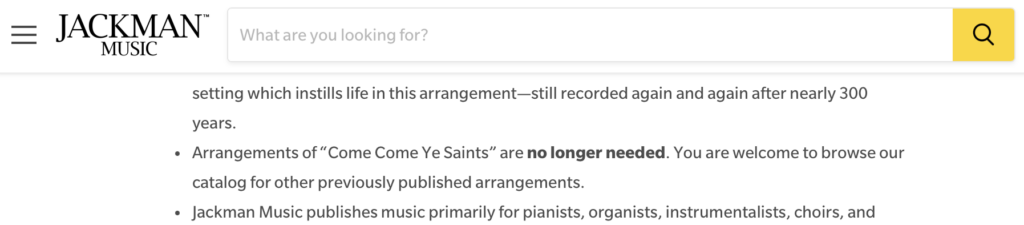
So, I went to the Jackman Music webpage for submitting music, and something caught my eye. A paragraph that said: “Arrangements of ‘Joseph Smith’s First Prayer’ and ‘Come, Come, Ye Saints’ are no longer needed. You are welcome to browse our catalog for other previously published arrangements.”
I suppose I would have normally ignored this, but I just so happened to have a great piano prelude on “Joseph Smith” and I was planning on submitting it. And I wondered: why would they single out these two arrangements? Why would they chant: “Arrangements! Arrangements! We have a ‘Joseph Smith,’ and we have a ‘Come, Come, Ye Saints.’ There cannot be any more arrangements!”
It did bring to my attention, though, that, indeed, these two hymns are very popular. “Joseph Smith’s First Prayer” is about the singular event that marks the beginning of our Church, and the tune is rather pretty and distinctive.
The other, “Come, Come, Ye Saints,” is probably the most popular Latter-day Saint hymn outside of our Church, because it’s based on the previously existing “All Is Well” tune, and the story of pioneers struggling with hardships and death can relate to most anyone.
And so — yes — there are literally hundreds of arrangements of these two hymns. But how many of them are any good? My “Joseph Smith” arrangement is likely better than most of any arrangement Jackman sells. Though, mine is more difficult to play, and probably less likely to make as much money.
But, you can imagine what I did. That’s right, I chose NOT to submit “Joseph Smith’s First Prayer” to Jackman Music. But that’s not all.
You see — I’m like John Locke on the TV Show LOST. Nobody’s going to tell me what I can’t do. That’s when the idea hit me. I already had “Joseph Smith,” so why not go ahead and do “Come, Come, Ye Saints” as well? Then it would a pair of awesome arrangements that together would NOT go to Jackman Music.
But then what would I do with them?
Well, it so happened that I submitted some other three arrangements to Jackman and about three arrangements to LDS Music Source, and I never heard back from them. I learned much later that sicknesses were probably much to blame, but it was too late. Since the biggest Latter-day Saint publishers had quietly rejected me, Melkim Publishing was born. That’s when I realized that I had the talent and the means … so why not? Don’t tell me what I can’t do.
BTW, if you don’t believe this story, you can visit Jackman Music today. Ten years later, it still says the same thing. Though you might notice that it no longer lists “Joseph Smith’s First Prayer.” That’s because of the event’s 200th anniversary in 2020, I think. So, it appears that “Come, Come, Ye Saints” is now the only hymn being banned.
Anyway, I knew the challenge: If “Come, Come Ye Saints” was going to catch anyone’s attention, it had to be good. Text painting was a must. No boring sleepy arrangements like most of those you can buy today.
And it took me a while to prepare. First I spent a lot of time creating and releasing Melkim Publishing on the world. So, it wasn’t until early 2018 that I finally started on “Come, Come, Ye Saints,” but in the end it was worth it.
Let me play some of my original piano version for you. Verse 1 begins the journey. Keep in mind that “saints” in our church means the members, themselves, rather than the canonized holy people you see in the Catholic Church. Like in “When the Saints Go Marching In.”
So, these saints are somewhat optimistic. “We’re happy. We’re on our way. With the right attitude, our hearts will swell.” I decided to go with the light walking theme you hear now. Perhaps, you can also hear horses trotting along as well.
In the second verse, the hardships are increasing, so I insert some intentional wrong notes to capture the pain, though they’re still trying to walk happily. In the second half of the verse, they’re remembering that God won’t forsake them.
The third verse talks about the destination from a distance, and so I place it very far away in a soft high register. But they will make it … they will arrive at the destination, and then they can shout praises to their God and King — so the volume increases — big rich chords. The last two “All is well”s in this verse are a bit tentative because they’re not there yet and something’s about to happen.
The fourth verse starts a funeral march. They’re still walking. Instead of G-major, I move it to the parallel g-minor. And when they sing about “Happy Day,” the music suddenly shifts into the key of Db-major. It’s a happy key, but in relation to the original G-major, almost all the notes are flatted, so it sounds sad at the same time. Like a heart-wrenching sad kind of happiness. When the music turns to the dead dwelling with the just, the music returns to the original G-major in full happiness. Those who die along the way will be taken care of in heaven.
But then the music opens up even more when singing about those whose lives are spared. They will see their rest at the end — so then the music gets quiet again. But wait — they’re going to make that music swell when they get there. And so we hear one last crescendo as the music swells to a wide chord.
And then it returns back to the beginning — the saints go back to marching along. Except — as my wife likes to point out: “They’re walking slower than they did in the beginning.” To which I respond: “Yes, because now they have experience. They’re still trying to be happy, but they’re much more realistic about their expectations.”
So you see … in this way I made an attempt to capture a full story in my arrangement. I finished it in early 2018. But that turned out not be the end of it.
About the same time, our stake choir had just performed my arrangement of “It Is Well with My Soul” for 6-part choir, piano, flute, and organ. So, I was on a roll. I figured our stake choir could do “Come, Come, Ye Saints” next. So, I started adding singing voices to the piano piece.
The first verse was easy — while expectations were simple and happy, I gave the singers the simple and straight melody and harmonies.
The second verse — a little more challenging. I had to give wrong notes to capture the pain, and match the interesting piano harmonies. It didn’t take too long to write those parts. Though … funny story … a few years later, I would decide that a couple of the bass notes were too “wrong” even for being intentional, and I ended up revising them. What you hear now is the original version.
The third verse is where things got interesting. The inspiration was to have the women start on a relatively high unison note — because as you know, far away in the West. And the harmonies would spread out from there. The men would come in later just under the altos. And the spread would continue in both directions — creating a growing beautiful swath of sound. However, there was one big issue.
In order for this all to work effectively, I had to split the women into four parts with tight harmonies. And the men as well. At that very moment, this was turning into a piece that might be too difficult for our stake choir. I tried to simplify the choral parts — but then the effect was lost. And I hit up against a wall that many church composers come up against. If you make the piece too hard, then you lose business because hardly anyone can perform it.
And the answer came to me then and there as I struggled. There are enough “easy” pieces out there for choirs to perform, and I had already promised myself that if I were to do “Come, Come, Ye Saints,” I would have to do a good job. Who was I then to ignore the inspiration I was receiving from God and his angels as I was composing?
Turns out that seven parts did the job: 4 women, and 3 men, and the desired effect was achieved. So, yes … fewer choirs can perform this, but it just wasn’t worth sacrificing the music itself.
And once that suit was cracked, the 4th verse is just crazy. Triplets against duplets … even more tight harmonies, and heart-wrenching chord progressions. I don’t think I can even start to explain what’s going on in this section. It just works, and I wasn’t going to ruin any of it with simplifications. I would just have to find a more advanced choir to sing it. Though, now I think our current stake choir could tackle it. Oh — we’ll see.
The last “music swell” chord was easy to write — a large tertiary chord — very effective to grasp the swell. And then a simple ending.
I finished this choral version in June 2018, and then I tried to get a choir to sing it — I was willing to provide the sheet music for free. One choir agreed, and loved it, but then the piano player left or got sick. Such is my luck. And then I just gave up trying to get it performed.
That was … until around September 2022. Yeah — four years later. I had seen a Facebook post in one of our Latter-day Saint composer groups. An orchestral choral conductor put out a general request: does anyone have any good orchestrations to share? My first inclination was to leave it all alone, because: I had nothing. But ultimately I did decide to respond to the conductor on Facebook and share a link to my piano choral MIDI rendition of “Come, Come, Ye Saints,” and I asked him, “Perhaps I should orchestrate this?” And no one responded. It’s like I just couldn’t get this music noticed by anyone. Was it that bad?
And then a few days later while I was listening to General Conference in October 2022, I got hit by a massive inspiration: “Drop everything immediately and do nothing else other than orchestrating ‘Come, Come, Ye Saints‘ and get ready to send it over to that conductor.” And have you ever heard the Spirit yelling in that still small voice? Well, that’s what it felt like.
The message was clear, so I immediately went to work, taking a break only on Sundays. I wanted to make an orchestration that would work both as an accompaniment to the choral rendition, and also as a standalone work.
I realized that in the area of text painting, I could do even more than I had before with an orchestra. On solo piano, the walking was simple, but now I could emphasize it with string pizzicati and the bassoon. And get this … a simple wood block and light snare drum gives us a horse. The other woodwinds double the choral parts — pretty!
For the second verse, I decided to capture the “pain” with a horn quartet. That sounds kind of funny, but it was the sound I wanted. And brass just fits the best in this verse. A marimba keeps the walking going.
The third verse: mainly a string pad, high woodwinds, and a celesta. It sounds simple and natural, but you wouldn’t believe how long it took me to get it all right. Really pretty. Halfway through the verse, the full orchestra comes in to praise God and King, complete with cymbals. And the music quiets down again on those tentative “All is well”s.
And the beginning of the fourth verse: I decided to feature the brass, and the snare drum with the snares turned off — sounding almost like a New Orleans funeral — giving the melody to trumpets. And almost randomly, a bell rings at a constant rate — a church bell. If you were to count them … yes … there are twelve chimes in there. I wanted to make sure the audience could actually feel death.
When it all opens up in the middle, I let it all go — full orchestra, louder chimes, etc. And again coming down suddenly for that rest being obtained.
And the final swell — well I could make it swell even more … and boy this really, really took a long time to get right. It even has a trumpet coming in a little early on top. Let’s hear that swell again. Here — I’ll turn off all the filters so you can hear it better.
And let me add in the chorus, too … we’ll hear that one more time.
And then it returns to pretty much the same orchestration as before, but also a little different.
So, with it finished on November 1, I put a recording on SoundCloud, and sent a link over to the conductor. Yeah — it only took me a month to put it all together. I did it all in Logic Pro.
And then I heard nothing back from the guy. What had I done wrong? Inspiration told me to continue working and get the music written on paper. And that part took me two months. Yeah — working with Finale, it can take that long to get it looking good and professional. And I really didn’t want bad engraving to hinder my chances. I was even working through the Christmas holidays, and through the first part of January. I had finally finished super-late on Saturday, January 14, and I had to get up early for church. I shouted “hooray” and went to bed after having worked so hard for three and a half straight months. But the Spirit wasn’t done with me. It told me: “Send it now.” So I got back up out of bed — 1 in the morning, and I sent it over.
Not even 12 hours later, the guy responded. This was Steve Danielson, and he said: I really like this, and I’m seriously considering it. And one week after that, he said: I’ve decided this will be in our October concert!
Boom! It worked. And it seems that I had barely gotten this in just in time — else I might have had to wait another year. And so it turns out: it was worth listening to these promptings — and all that work had panned out.
This was the Ensign Symphony & Chorus in Seattle, and I immediately started planning a big one-week vacation around the event. It was a blast, and you can read all about the trip on my music blog. I’ll provide a link in the video description.
One thing I’ll mention here: after the performance, I got to stand up and take a bow among the audience. After the concert, a person sitting in front of me turned around and told me about how that was his favorite hymn, and I had done a good job capturing the lyrics. And I signed a few autographs. A few of the singers even commented about how happy they were that they got to sing this version before the Tabernacle Choir did.
Now I can look back and say: sorry, Jackman Music, it looks like the world could use more arrangements of “Come, Come, Ye Saints” after all. Sorry, people who tell me my music is too hard and needs to be simplified: I found someone who could perform it. And finally, great things happen to those who listen to and follow the promptings of the Spirit.
And now, this music is ready for others who’d like to perform it as well, whether it be the piano version, the choral version, or orchestral. I do warn that each arrangement is a challenge, but I promise it would be worth it.
For those of you who’d like to hear the full recording of the Ensign performance, I’ll provide a link in the video description. And just to let you know, there is a lot more where this comes from, and I am nowhere near finished with my mission. So stay tuned for more exciting developments.
Please Like and Subscribe … and thank you for watching. I’ll catch y’all later.
by
Tags:
Leave a Reply